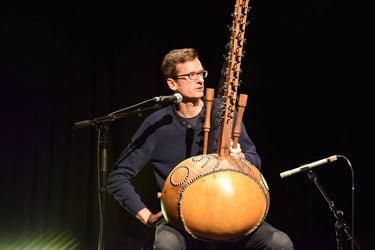
I went back to Belgium for a year, but I wanted to keep learning, so I left again for another stay. I had progressed a lot, but things didn't go as planned this time. I stopped making progress and felt like I was going in circles — I even decided to go to Gambia to find other teachers. When I mentioned this to Toumani Diabaté, he told me it would be dishonorable to do that, and instead offered to let me live with him.
That's when everything shifted. I fell seriously ill — nearly dying from malaria and typhoid. Without the help of Dr. Modibo Sangaré, one of the most virtuous people I've ever met, I wouldn't have made it. I wasn't progressing. So I decided to take matters into my own hands and started learning Western pieces on the kora between bouts of fever. What I didn't know was that one evening, Toumani, who was in the courtyard, heard me practicing.
The master summoned me...
He told me something to the effect that this was my path — that I needed to take what I'd learned from the Mandinka tradition and apply it within my own culture, since I would never be able to reach their level within their own style, and that was why I felt stuck.
It hit me like a shock, but without telling anyone, I went and bought my return ticket.
I visited an elder to share my decision to leave, and he told me it was the best thing I could do — because in Mali, only a father teaches his son the "secrets" of his playing, and people like me, being outside the djeli circle, can only receive the surface-level, accessible parts.
He shared a few other things with me that can't be repeated here, but I listened closely. He told me that, traditionally, knowing one piece and being able to tune the kora was more than enough to become a kora player — the rest had to come from sheer determination and from listening to others.
The world of musicians in Mali is an extremely tough one, given the scarcity of opportunities and the pressure to stand out in order to go abroad or compete for the few available stages. People don't hand over their trade secrets just for money — as I said, it's passed from father to son, behind closed doors, on top of the traditional initiations reserved for djelis.
Returning to Belgium was brutal — no bearings, no guide. But I'd had an idea one Sunday in Bamako, watching everyone crowd around TVs to watch Bollywood clips.
That gave me the urge to learn Indian music, and before heading back to Belgium, I reached out to hundreds of music teachers, looking for someone who could teach me Indian music on the kora.
I only got three replies, including one from a singer, Mr. Bose, a Carnatic music teacher at the University of Pondicherry.
I saved for two years before leaving for six months in India to study with him. Mr. Bose told me to leave the kora at home, since all the learning would happen through singing. I hadn't expected that, but out of necessity, I became a singer...